Complete Analysis of the Proposed House Requisition Allowance for Secretariat Employees
Meta Title: House Requisition Allowance (HRA) Proposed Rates in KPK 2026 – Complete Analysis
Meta Description: Read a detailed analysis of the proposed House Requisition Allowance (HRA) rates in Khyber Pakhtunkhwa (KPK) for 2026, including proposed rates, financial implications, BPS-wise comparison, and expected impact on government employees.
House Requisition Allowance (HRA) – Proposed Rates of HRA in KPK 2026
The Government of Khyber Pakhtunkhwa (KPK) has proposed a significant revision in the House Requisition Allowance (HRA) for Secretariat employees. The proposal aims to address the increasing cost of accommodation, inflation, and disparities in rental ceilings among different provinces and the Federal Government.
The attached financial statement titled “Financial Implications on Granting House Requisition Allowance to Secretariat Employees” presents a detailed comparison between the existing House Rent Allowance, rental ceilings across Pakistan, and the proposed HRA rates for employees from BPS-1 to BPS-22.
This proposal is expected to substantially improve housing support for thousands of government employees while also increasing the government’s annual expenditure.
What is House Requisition Allowance (HRA)?
House Requisition Allowance (HRA) is a special housing allowance provided to eligible government employees who are not residing in government-owned accommodation.
Unlike the traditional House Rent Allowance (HRA), which is calculated as a fixed percentage of pay, the proposed House Requisition Allowance is based on realistic rental values and aims to compensate employees according to actual housing costs.
The allowance is particularly important for Secretariat employees posted in urban areas where rental expenses have increased significantly over the past decade.
Why Was This Proposal Introduced?
The proposal has been prepared due to several reasons:
- Rapid increase in residential rents.
- Existing House Rent Allowance has become outdated.
- Huge difference between government allowance and actual market rent.
- Variation in rental ceilings across provinces.
- Need to provide equitable housing support.
The proposal compares rental ceilings of:
- Punjab
- Federal Government
- Sindh
- Balochistan
After comparing all four, an average rental ceiling has been calculated, which forms the basis of the proposed HRA.
Key Highlights of the Proposal
According to the attached financial statement:
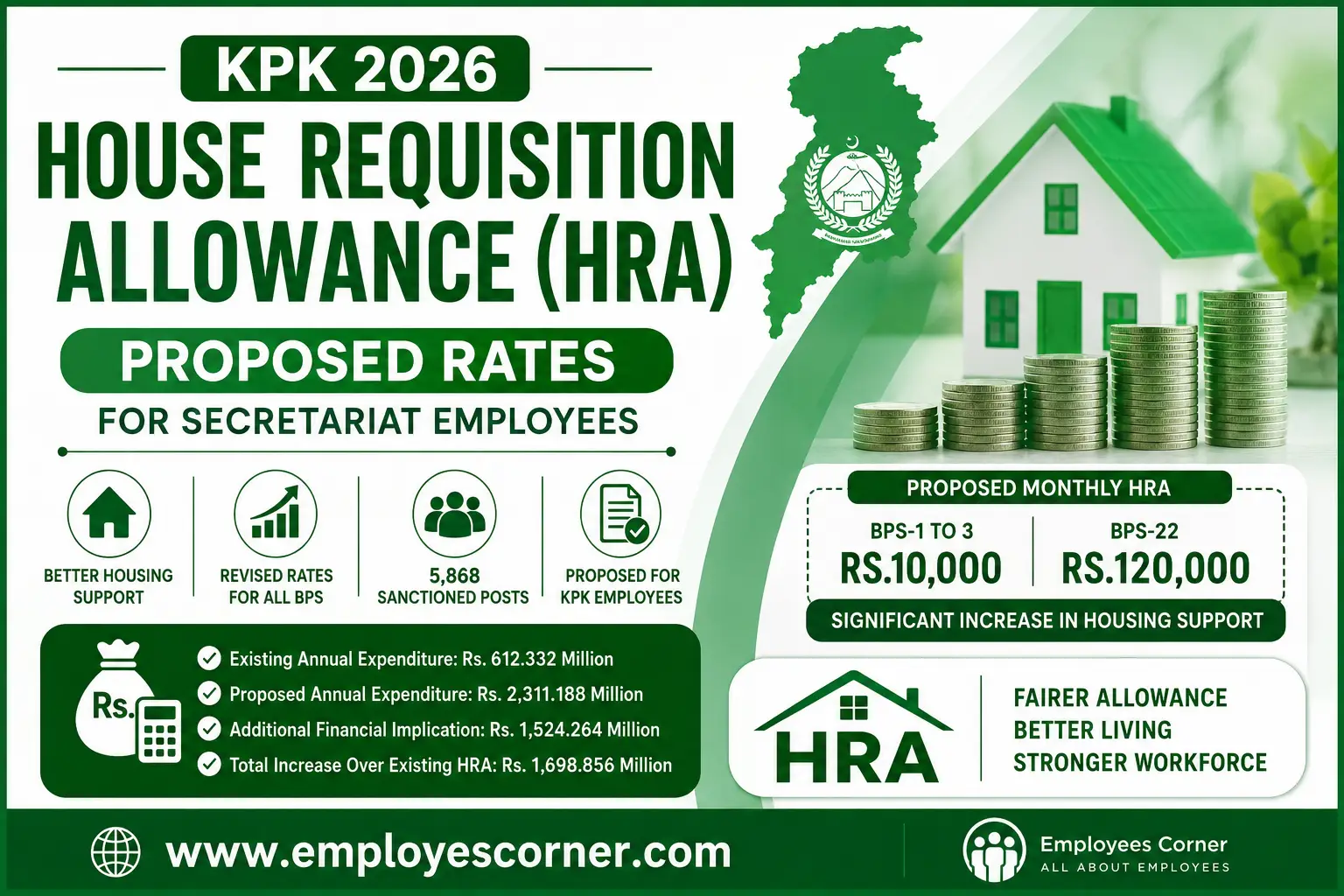
- Total sanctioned posts covered: 5,868
- Existing annual House Rent expenditure: Rs. 612.332 million
- Proposed annual HRA expenditure: Rs. 2,311.188 million
- Additional annual financial implication: Rs. 1,524.264 million
- Overall increase over existing House Rent expenditure: Rs. 1,698.856 million
This represents a substantial increase in housing-related expenditure, reflecting the government’s effort to align allowances with prevailing rental markets.
Basis of Calculation
Instead of adopting the rental ceiling of one province only, the committee averaged the rental ceilings of:
| Province | Rental Ceiling Considered |
|---|---|
| Punjab | Included |
| Federal Government | Included |
| Sindh | Included |
| Balochistan | Included |
The average of these four ceilings was then used to estimate an appropriate House Requisition Allowance for each Basic Pay Scale.
Proposed HRA Rates (BPS-wise)
The proposed monthly House Requisition Allowance is as follows:
| BPS | Proposed Monthly HRA |
|---|---|
| BPS-1 | Rs.10,000 |
| BPS-2 | Rs.10,000 |
| BPS-3 | Rs.10,000 |
| BPS-4 | Rs.14,000 |
| BPS-5 | Rs.14,000 |
| BPS-6 | Rs.14,000 |
| BPS-7 | Rs.14,000 |
| BPS-8 | Rs.18,000 |
| BPS-9 | Rs.18,000 |
| BPS-10 | Rs.18,000 |
| BPS-11 | Rs.24,000 |
| BPS-12 | Rs.24,000 |
| BPS-13 | Rs.24,000 |
| BPS-14 | Rs.34,000 |
| BPS-15 | Rs.34,000 |
| BPS-16 | Rs.34,000 |
| BPS-17 | Rs.50,000 |
| BPS-18 | Rs.58,000 |
| BPS-19 | Rs.66,000 |
| BPS-20 | Rs.82,000 |
| BPS-21 | Rs.105,000 |
| BPS-22 | Rs.120,000 |
These proposed rates are considerably higher than the existing House Rent Allowance currently being drawn by employees.
Comparison with Existing House Rent Allowance
The existing House Rent Allowance ranges approximately between:
- Rs.2,697 (BPS-1)
- Rs.32,292 (BPS-22)
The proposed allowance increases this substantially:
Example:
BPS-1
Existing:
Rs.2,697
Proposed:
Rs.10,000
Increase:
Approximately 271%
BPS-11
Existing:
Rs.6,909
Proposed:
Rs.24,000
Increase:
More than 247%
BPS-17
Existing:
Rs.12,557
Proposed:
Rs.50,000
Increase:
Nearly 300%
BPS-22
Existing:
Rs.32,292
Proposed:
Rs.120,000
Increase:
Around 272%
The proposal therefore represents one of the most significant revisions in housing-related benefits for Secretariat employees.
Financial Implications
The financial statement estimates:
Existing House Rent Expenditure
Rs.612.332 Million per annum
Proposed HRA Expenditure
Rs.2.311 Billion per annum
Additional Annual Burden
Rs.1.524 Billion
Difference Compared to Existing HRA
Rs.1.699 Billion annually
Although this is a considerable increase in expenditure, the proposal argues that the current allowance no longer reflects actual rental costs.
Employees Benefiting from the Proposal
The proposal covers Secretariat employees from:
- BPS-3
- BPS-4
- BPS-5
- BPS-6
- BPS-7
- BPS-8
- BPS-9
- BPS-10
- BPS-11
- BPS-12
- BPS-13
- BPS-14
- BPS-15
- BPS-16
- BPS-17
- BPS-18
- BPS-19
- BPS-20
- BPS-21
- BPS-22
The financial calculations are based on 5,868 sanctioned posts.
Employees Excluded
According to the note provided in the financial statement:
The following employees are not included:
- Employees residing in Government accommodation.
- Employees already receiving Housing Subsidy Allowance.
This ensures that the benefit is targeted toward employees who actually bear private rental expenses.
Why This Proposal is Important
Housing is one of the largest monthly expenses for government servants.
During the last several years:
- Inflation has increased.
- Property prices have risen.
- Monthly rents have doubled in many cities.
- Existing House Rent Allowance has remained insufficient.
The proposed HRA attempts to bridge this gap by linking housing support to realistic rental ceilings.
Impact on Employees
If approved, employees would receive:
- Better housing support.
- Reduced financial burden.
- Improved living standards.
- Greater ability to rent accommodation near workplaces.
- Enhanced employee satisfaction.
For officers in BPS-17 and above, the revised allowance could significantly reduce out-of-pocket housing costs, especially in major urban centers.
Impact on Government Finances
While employees stand to benefit, the government will need to allocate substantial additional resources.
The estimated increase of over Rs.1.5 billion annually reflects a major fiscal commitment. Policymakers will need to balance employee welfare with budgetary constraints before implementation.
Is This Proposal Approved?
Based on the attached document, this is a financial proposal prepared to assess the implications of granting House Requisition Allowance to Secretariat employees.
The document outlines proposed rates and estimated costs. It does not, by itself, confirm that the proposal has been officially approved or notified. Employees should therefore wait for an official government notification before expecting implementation.
Conclusion
The proposed House Requisition Allowance (HRA) for KPK Secretariat employees represents a major step toward modernizing housing benefits in line with current rental realities. By using the average rental ceilings of Punjab, the Federal Government, Sindh, and Balochistan, the proposal seeks to establish a more equitable allowance structure across all Basic Pay Scales.
If approved, the new HRA would provide substantial financial relief to eligible employees, particularly those serving in cities where rental costs have risen sharply. However, the proposal also carries a significant financial implication for the provincial government, with annual expenditure increasing from approximately Rs. 612 million to over Rs. 2.31 billion.
Until an official notification is issued, these figures should be regarded as proposed rates rather than finalized entitlements. Government employees are advised to follow official announcements from the Government of Khyber Pakhtunkhwa regarding the status and implementation of this proposal.